Your Analysts Are Drowning - And AI Alone Won't Save Them
Analysts are buried in repetitive work, and AI without structure only adds chaos. Learn why human-AI collaboration matters.
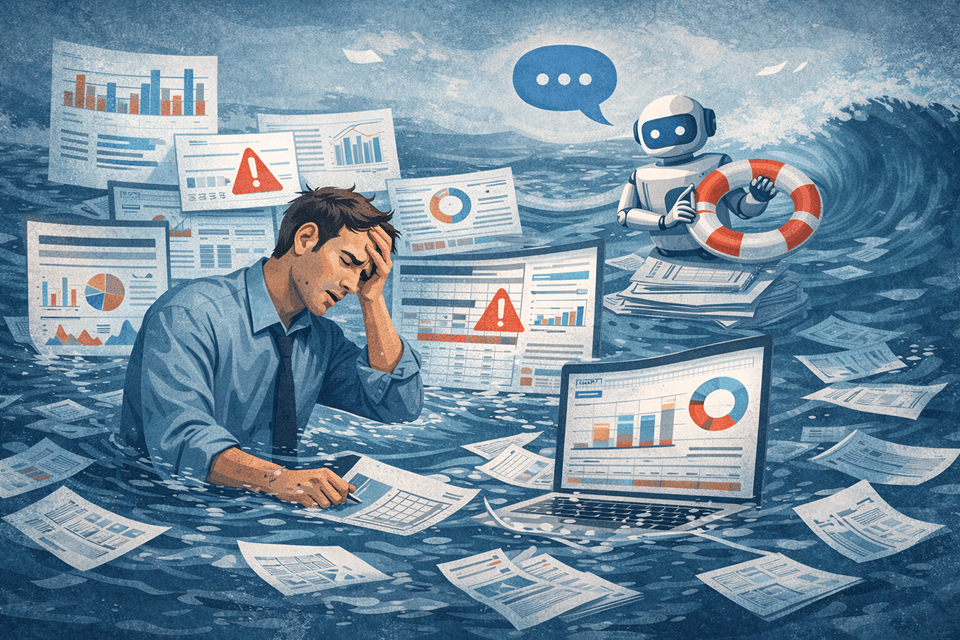
Somewhere in your organization right now, a talented analyst is copy-pasting data between spreadsheets. They're reformatting a report they've reformatted twelve times before. They're answering the same ad hoc request they answered last Tuesday with slightly different date parameters.
They didn't take this job for this.
The analytics talent shortage is one of the most discussed problems in business today. Companies compete aggressively for people who can turn data into decisions. They pay well, offer flexibility, and invest in tools. And then they watch those people spend the majority of their time on work that is repetitive, mechanical, and deeply unfulfilling.
This isn't a pipeline problem. It's a systems problem.
When analytics processes aren't structured -- when every request starts from scratch, when institutional knowledge lives in one person's head, when there's no framework for how questions get asked and answered -- skilled people become glorified data wranglers. And eventually, they leave. Or worse, they stay and quietly disengage.
AI has been pitched as the answer. Load up a large language model, connect it to your data warehouse, and let people ask questions in plain English. The demo is always impressive. The reality is messier.
AI without structure amplifies chaos. When there's no shared definition of what a "conversion" means, AI generates three different answers to the same question depending on how it's asked. When there's no data governance layer, AI confidently produces numbers that are subtly, silently wrong. When there's no human checkpoint in the workflow, bad outputs compound into bad decisions.
The analysts who were supposed to be freed are now cleaning up AI mistakes instead of spreadsheet mistakes. Different problem. Same exhaustion.
MAX takes a different approach.
Rather than replacing analysts with AI, MAX builds AI into a structured collaborative workflow -- one where human judgment and AI capability reinforce each other. Analysts define the logic. AI scales it. Humans review the outputs. AI handles the repetition. The process is documented so knowledge doesn't disappear when someone leaves.
The result is an analyst who spends their day doing what they were actually hired to do: asking better questions, finding unexpected patterns, and translating data into strategic direction. Not reformatting. Not re-explaining. Not firefighting.
Your analytics talent is one of your most expensive and most fragile assets. The way you deploy them either amplifies or erodes that investment.
MAX is built on the belief that the best analytics work happens when humans and AI each do what they're genuinely good at -- and neither tries to replace the other.
Your analysts don't need to be saved from data. They need to be freed from busywork. There's a difference, and it matters.