Why Most Companies Are Not Actually AI-Ready (And What That Means for Your Analytics)
AI strategies are everywhere, but AI-ready foundations are rare. Learn the governance, workflows, and auditability required for trustworthy AI analytics.
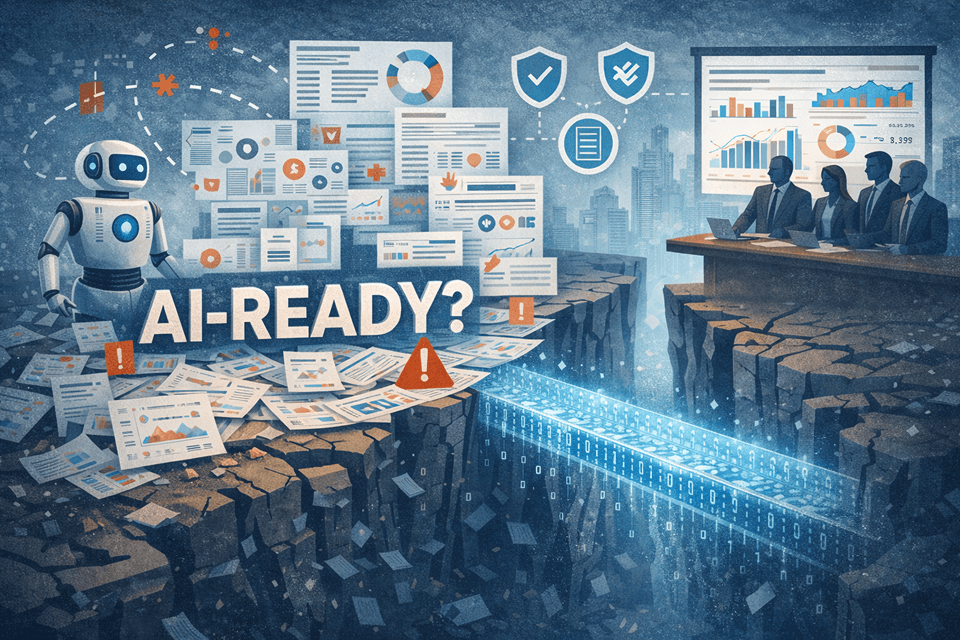
Every major company has announced an AI strategy. Most of them have a problem they haven't named yet.
The announcements are real. The investments are real. The ambition is real. But when it comes time to actually run AI-powered analytics at scale -- to generate reliable, consistent, auditable insights from AI -- many organizations discover a quiet, expensive gap between their AI aspirations and their data reality.
AI doesn't fix messy data. It amplifies it.
Here's what AI-readiness actually requires, beneath the vendor promises:
First, it requires clean, well-governed data with consistent definitions. "Revenue" means one thing in finance, another in sales operations, and a third in the marketing attribution model. When AI is asked to analyze revenue, it will pick one. It won't tell you which one, and it won't ask.
Second, it requires structured analytical workflows. AI is extraordinarily good at pattern recognition and scale. It is not good at judgment calls about business context, stakeholder priorities, or the strategic nuance behind a metric. Without a human workflow wrapped around AI capability, those judgment calls get made silently -- by default settings, by training data, by probabilistic outputs that look like decisions.
Third, it requires auditability. When an AI-generated insight influences a business decision, someone needs to be able to trace that insight back to its source. Regulators are beginning to ask for this. Boards are beginning to ask for this. The ability to show your work is no longer optional.
Most companies investing in AI analytics today are building on foundations that weren't designed for this moment. They're connecting AI tools to data infrastructure built for reporting, not reasoning. The result is analytics that's fast but fragile -- impressive in demos, unreliable in production.
MAX was architected specifically for the AI era.
Not retrofitted. Not adapted. Built from the ground up around the requirements of human-AI collaboration at scale.
The MAX infrastructure treats data governance as a first-class feature, not an afterthought. Definitions are standardized and shared. Metrics are documented and versioned. When something changes -- a business rule, a data source, a strategic priority -- the change is visible, intentional, and reflected consistently across outputs.
The MAX workflow is designed so AI works within a human-defined structure. Analysts set the parameters. AI executes within them. Outputs are reviewable before they become decisions. The speed of AI is captured without sacrificing the judgment that makes analytics trustworthy.
And MAX is auditable by design. Every analysis carries a chain of logic that can be reviewed, questioned, and defended. Not because it's legally required (though increasingly it will be), but because trustworthy analytics requires it.
The companies that will win in the AI era aren't necessarily the ones that move fastest to adopt AI. They're the ones that build the right infrastructure to use AI reliably.
Being AI-ready isn't a slogan. It's architecture. And the time to build it is before the stakes get higher.