Intelligence at Scale - Why the Future of Analytics Is Architecture, Not Just AI
The next wave of analytics is about architecture, not just tools. Meet the Intelligence Framework that makes AI reliable at scale.
We are at an inflection point in how businesses use data.
For the past decade, the analytics conversation has centered on tools: which BI platform, which data warehouse, which visualization software. The assumption was that better tools would produce better insights. And they did -- up to a point.
The next wave of analytics capability isn't coming from better tools. It's coming from better architecture.
This distinction matters enormously as AI enters the analytics stack. AI can dramatically accelerate analysis. It can surface patterns invisible to human review. It can scale analytical capacity without scaling headcount. But AI applied to a poorly architected analytics environment doesn't produce better insights -- it produces faster bad insights, at greater volume, with more convincing presentation.
The companies that will lead in the AI era are building analytics intelligence into their operations as infrastructure -- not as a collection of tools, but as a systematic capability that spans how questions get asked, how data gets governed, how analysis gets executed, and how insights get acted on.
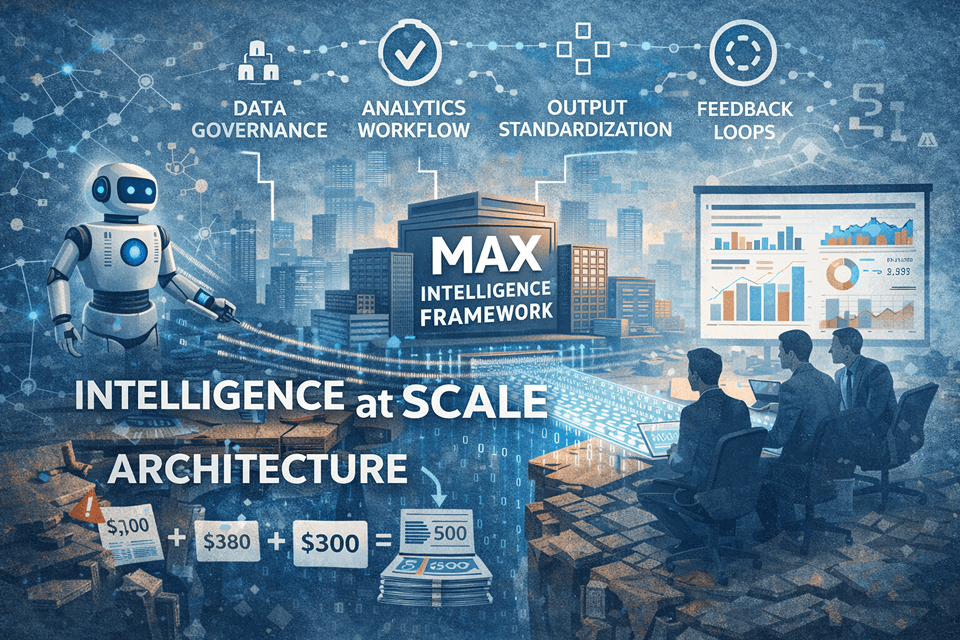
This is what MAX calls the Intelligence Framework: a structured approach to analytics that treats the entire workflow -- from business question to data to insight to decision -- as a designed system rather than an improvised process.
The components of this framework aren't complicated. But they are intentional.
Data governance establishes shared definitions and ownership. This sounds basic because it is basic -- and it's missing from most organizations. When a business scales past a certain complexity, definitions fragment. Different teams use the same terms differently. AI doesn't resolve this ambiguity; it inherits it. Governance is the foundation on which everything else is built.
Analytical workflow design determines how human judgment and AI capability interact. The best analytical workflows are neither fully automated nor fully manual -- they're collaborative. AI handles volume, speed, and pattern recognition. Humans handle context, strategy, and review. The workflow specifies where each contributes, and where handoffs happen.
Output standardization ensures that insights are consistently formatted, documented, and traceable. This isn't about aesthetics. It's about institutional memory. When insights are generated in a standardized structure, they can be compared over time, reviewed by new team members, and audited when questions arise.
Feedback loops connect analytical outputs back to the questions that generated them. When a decision is made based on an insight, was the insight right? Organizations that close this loop improve continuously. Organizations that don't repeat the same analytical mistakes at scale.
MAX operationalizes this framework in a platform designed specifically for human-AI collaboration. The intelligence isn't just in the AI. It's in the architecture that makes AI trustworthy.
For companies investing in AI analytics today, the most important question isn't "which AI tool should we use?" It's "do we have the architecture to use AI reliably?" The tool decision is secondary. The infrastructure decision is foundational.
The organizations building analytics intelligence as infrastructure today are creating compounding advantages -- each analysis improves the framework, each framework improvement improves future analyses, and the whole system gets smarter over time in a way that's specific to the organization's context and needs.
This is what it means to be genuinely AI-ready. Not just having AI in your stack. Having the architecture to use it well.
MAX exists to make that architecture accessible -- not just to enterprises with teams of data engineers, but to any organization serious about turning analytics into a durable competitive advantage.
The future of analytics isn't a better dashboard. It's a smarter system. And the time to build it is now.